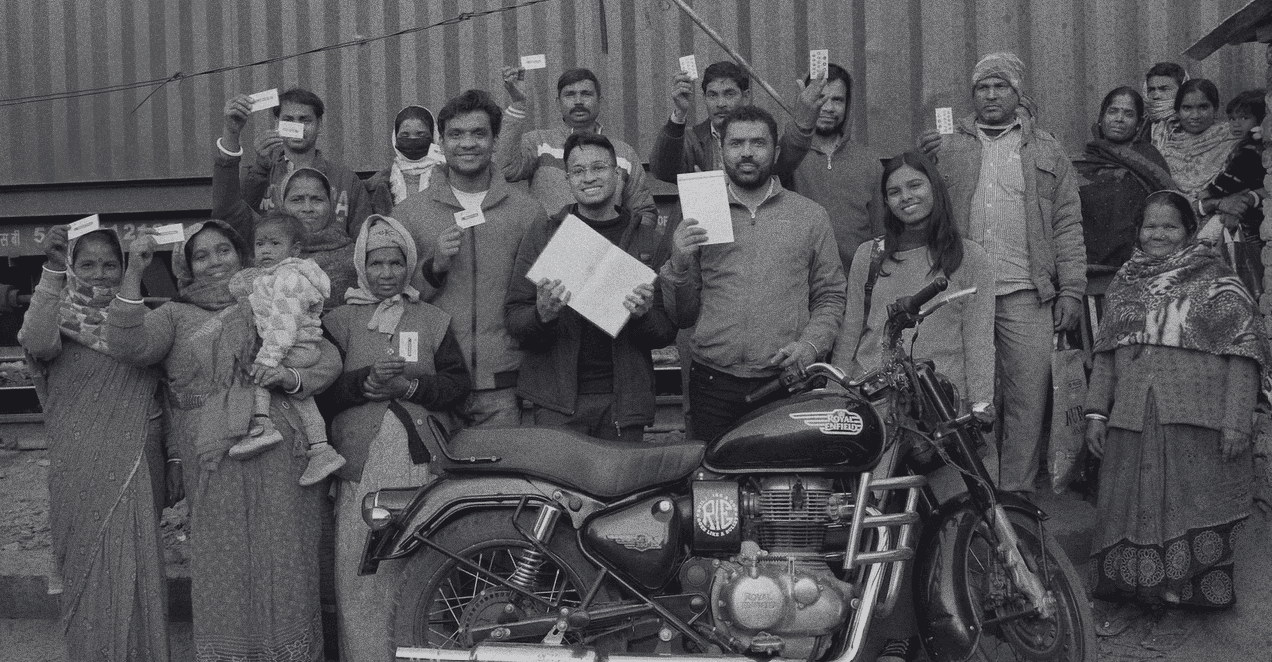
Over a billion Indians qualify for free legal aid.

Yet, for 95% of them, it remains inaccessible.

For millions of people, justice exists merely on paper, not in practice.

Migrant workers, displaced persons, and low-income communities are routinely denied the rights and protections the law guarantees them. Where poverty, displacement, and gender intersect, the barriers to justice run deepest. 

Women and girls are excluded first, and reached last. Without access to justice, entire communities stay trapped in cycles of exploitation, abuse, and exclusion.

This is the gap MAP seeks to address.

About the

Organisation

About the

Organisation

Margins to Access Project (MAP), formerly known as the Migration and Asylum Project, is a legal aid centre committed to facilitating access to justice through systemic and sustainable change.

Working at the intersection of migration, gender, and justice, we operate from the grassroots to the highest institutions to decentralise and democratise the justice system. 

We recognise that overlapping forms of marginalisation demand more than a one-size-fits-all approach to justice, and are deeply committed to addressing the devastating impact of poverty, migration and displacement on communities, particularly women and girls. 

The deer carrying the scales of justice symbolises the right of marginalised communities to seek, access, and claim justice on equal terms.

The deer carrying the scales of justice symbolises the right of marginalised communities to seek, access, and claim justice on equal terms.

We take the law to those who need it most; turning rights into reality and making justice systems accessible to those who have been excluded from it for far too long.

We take the law to those who need it most; turning rights into reality and making justice systems accessible to those who have been excluded from it for far too long.

We take the law to those who need it most; turning rights into reality and making justice systems accessible to those who have been excluded from it for far too long.

Our Roadmap to Justice

We believe that meaningful access to justice requires both empowered communities and responsive institutions.
By addressing barriers at both the systemic and grassroots levels, we work towards a justice system that serves the most vulnerable, and therefore, everyone.


Building stronger pathways to justice: From communities to institutions

Problem: The justice system struggles to serve its most vulnerable, for whom justice remains only a notional right.

Community: Marginalised communities, especially women and girls, affected by migration, poverty and displacement.

Reach: We work across Delhi, Himachal Pradesh, Mizoram and Uttarakhand through formal collaborations with legal institutions.

Approach: MAP's holistic model works at two levels simultaneously.

At the community level, direct interventions provide tailored legal assistance, while at the institutional level, we engage duty-bearers to build systems that are more accessible, responsive, and victim-centred.

Scroll to read more.

Our Impact


0+
clients provided legal assistance
0mn
impacted across India
0+
pro bono hours committed annually
0+
legal aid personnel trained
0+
clients provided legal assistance
0mn
impacted across India
0+
pro bono hours committed annually
0+
legal aid personnel trained
0+
clients provided legal assistance
0mn
impacted across India
0+
pro bono hours committed annually
0+
legal aid personnel trained

Our Work

Use the arrows to scroll through the 4 programmes MAP is currently working on


Our Work

Use the arrows to scroll through MAP's 4 programmes

Nyaay

Sabha

Nyaay

Sabha

MAP's annual  flagship justice convening 'Nyaay Sabha' has, over the years, evolved as a space bringing together influential voices from the justice ecosystem to reimagine what 'last-mile justice' could truly mean.


The 2026 event saw the unprecedented coming together of 260 diverse actors: members of the Bar and Bench, civil society organisations, academia, students, philanthropists, and institutional actors from the National Legal Services Authority and the Department of Justice, each bringing a distinct perspective to a conversation about legal aid that has, for too long, remained siloed.

Our Supporters

Approach and Strategy

Our Roadmap to Justice

We believe that meaningful access to justice requires both empowered communities and responsive institutions.

By addressing barriers at both the systemic and grassroots levels, we work towards a justice system that serves the most vulnerable, and therefore, everyone.


Our Roadmap to Justice


We believe that meaningful access to justice requires both empowered communities and responsive institutions.

By addressing barriers at both the systemic and grassroots levels, we work towards a justice system that serves the most vulnerable, and therefore, everyone.

Building stronger pathways to justice: From communities to institutions

MAP works at two levels simultaneously. At the community level, direct interventions provide accessible legal assistance, while at the institutional level, MAP engages duty-bearers and partners to bridge the legal aid gap and build systems that are more accessible, responsive, and people-centred.

Problem: The justice system struggles to serve its most vulnerable, for whom justice remains only a notional right.

Community: Migrant communities, especially women are vulnerable to rights violations without avenues for redress.

Reach: We work with institutions and communities across Delhi, Himachal Pradesh, Mizoram and Uttarakhand.

Approach: MAP's holistic model works at two levels simultaneously.

At the community level, direct interventions provide tailored legal assistance, while at the institutional level, we engage duty-bearers to build systems that are more accessible, responsive, and victim-centred.

01 Awareness

01 Awareness

Building public awareness about laws so communities understand their rights.

Building public awareness about laws through community-based campaigns, art, theatre, and multimedia tools, to make legal information accessible.

Building public awareness about laws through community-based campaigns, art, theatre, and multimedia tools, to make legal information accessible.


02 Accessibiltiy

02 Accessibiltiy

Making justice systems easier to access through community-based structures.

Making legal protection easier to access through a network of first responders, mobile legal desks, and linkages to local support structures.

03 Assistance

03 Assistance

Promote meaningful access to justice through formal legal aid.

Promoting meaningful access to justice through court representation and mediation, by a panel of expert pro bono lawyers and paralegals.


04 Accountability

04 Accountability

04 Accountability

Strengthening institutions and systems to make justice delivery more responsive and accountable.

Supporting state legal aid institutions and justice systems to make justice delivery more democratic, responsive and client-centric.